David Séchard
Illusions perduesDavid Séchard is a learned printer, loyal friend, and persistent inventor whose life joins private self-sacrifice to a consequential industrial discovery. He gives Lucien de Rubempré money, shelter, and the freedom to pursue literary ambition; loves and marries Ève Séchard; and develops a cheaper way to make paper from materials other than rags. Yet the same generosity and intellectual absorption that shape his best work leave him vulnerable to commercial pressure. His invention enters French manufacturing, while David himself retreats from public recognition into family life and the patient study of insects.
Identity and Background
David is the only son of Jérôme-Nicolas Séchard, a printer whose practical intelligence is sharpened by avarice. His father sends him to the lycée in Angoulême and then to Paris to study advanced typography, but makes clear that David must not expect financial support. David completes his education while learning his trade at the Didot Printing House, becoming a scholar as well as a trained printer. In late 1819 he returns to Angoulême at his father’s summons, prepared to take charge of the family establishment.
The business David inherits is not an easy foundation for prosperity. It has lost the judicial-announcement newspaper that once helped secure its trade, and the Cointet brothers have acquired the other printer’s license in Angoulême. Their own business combines printing, bookselling, and paper-making, and their Courrier de la Charente is now the department’s sole newspaper. David’s father has arranged the transfer of the family printing business on terms that preserve his own advantage, including continued rent for the premises. The enterprise brings David only modest income: after wages, taxes, and rent, his share is about one hundred francs a month. He is thus educated and capable, but placed in a precarious business against better-capitalized competitors.
David’s temperament makes the mismatch sharper. While more active competitors might replace type, buy iron presses, and seek new work from Paris publishers, he and Lucien become absorbed in intellectual labor and accept the jobs already coming to them. The Cointets understand David’s habits and keep his press alive by sending it minor local work, a calculated accommodation that prevents it from falling into the hands of a more formidable rival. David is not simply defeated by a lack of talent: his reflective disposition and limited means bind him to a business whose apparent survival is partly managed by its competitors.
Friendship, Love, and Devotion
Soon after taking up his position, David encounters his former schoolmate Lucien, who is living in extreme poverty and close to despair. David gives him forty francs a month and offers to train him as a printing-house foreman, although he has no real need for another foreman. The practical offer becomes a renewed friendship. Both young men feel that their abilities exceed the low social position into which they have been cast, but their inclinations diverge: Lucien seeks literary fame, while David, whose meditative nature inclines toward poetry, is drawn to exact science.
Their friendship deepens into a chosen brotherhood. Lucien shares ideas inherited from his father about applying science to industry; David, in turn, helps Lucien imagine ways to make a name and fortune in literature. David’s loyalty is not detached from his feelings for Lucien’s family. He falls in love with Ève, Lucien’s sister, but approaches her timidly, afraid both of imposing on her and of being unworthy. Ève is gentle, devoted, and accustomed to labor; the two keep their feelings private, and David’s affection shows itself in careful respect rather than a bold declaration. He sometimes walks from Place du Mûrier toward L’Houmeau, only to turn back at the gate rather than risk disturbing her.
When Lucien hopes to enter the social world around Madame de Bargeton, David declines to follow him. He sees the difference between their positions: Lucien, as a poet without a fixed occupation, may still move toward honors, while David is already identified with the tradesman’s life. He urges Lucien to use that freedom, and offers himself as the steadfast support behind his friend’s public ambitions. His generosity is not merely financial. David is willing to let Lucien take the visible place he believes suits him, while he remains in the background, ready to help if success turns to betrayal or failure.
David also fears that Lucien’s new social ambitions will estrange him from work and expose him to expenses he cannot sustain. He warns Ève that literary success depends on solitude and sustained labor, while the demands of fashionable society may consume Lucien’s time and intensify his desire for luxury. Yet his warning leads not to withdrawal but to a proposal of marriage. He asks Ève to marry him partly so that Lucien can receive help without shame: as David imagines it, their household could provide his friend with a secure base and, if necessary, support his eventual move to Paris. He explains that Ève’s thrift and practical ability complement his own scientific imagination, and discloses that he is pursuing an industrial discovery that may eventually make the family wealthy. His love is therefore expressed through a shared plan of work and support, though its stated purpose is initially the welfare of Lucien as much as their own happiness.
The Printer and the Inventor
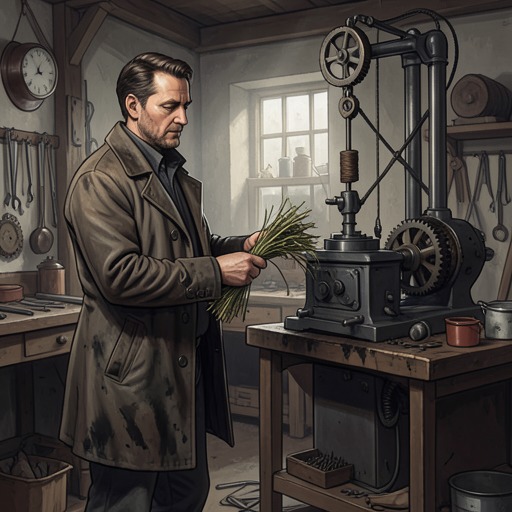
David’s industrial ambition grows from an idea Lucien recalls from their late father, Monsieur Chardon: plant materials available from the Americas might be used to reduce the cost of paper, just as a new chemical agent might lower the price of sugar. David seizes on the paper-making possibility and sees in it a route to fortune. It is a striking reversal of their roles: Lucien supplies the remembered notion, while David undertakes the patient investigation needed to turn it into a process.
The work fits the larger change David perceives around him. As newspapers, publishing, politics, scientific discussion, and public debate expand, he anticipates a greatly increased demand for paper. He understands the material side of a transformation that Lucien encounters on the journalistic side: while Lucien enters the press and risks his honor and intelligence in its machinery, David asks how the paper that machinery consumes can be made more cheaply. His forecast is practical and historically consequential, but David lacks the capital and commercial ruthlessness required to secure the result for himself.
The strain of supporting Lucien continues even as David’s own resources narrow. At one point he has only two thousand francs left, half of which is necessary to keep the printing works operating. When Lucien needs money, David recognizes that giving him a thousand francs means risking their own bread and security. Ève nonetheless urges him to act as if he were alone and promises to earn back the sum through her labor. Their decision shows how support for Lucien is shared within the household, but also how readily the couple converts its scant reserves into aid for him.
Later, when Lucien is struggling in Paris, David sends a bill for two hundred francs payable in ninety days, negotiable through the paper merchant Métivier on Rue Serpente. He signs it without Ève’s knowledge because he believes there is no other way to help. In his letter he praises Ève for taking charge of the printing works with patience and energy, and encourages Lucien to remain with the literary companions he has found rather than fall into destructive company. Ève, meanwhile, writes that she and her mother have pawned a few possessions to send Lucien a further hundred francs. She describes David’s absorption in paper-making experiments and reveals that she is pregnant, a joy overshadowed by the family’s financial anxieties. The correspondence makes visible the household cost of David’s loyalty: his wife runs the business, his mother-in-law resumes exhausting work, and the family parts with possessions while David pursues a discovery he hopes will ultimately secure their future.
Debt, Exploitation, and Discovery
Lucien’s assistance from David eventually becomes a source of grave danger. In Paris, Lucien forges three promissory notes for one thousand francs apiece, imitating David’s signature and discounting them through Métivier. He tells David afterward and promises to provide the funds when the notes mature. The bills expose David and his family to debt and legal proceedings. When Lucien returns to the region on foot, worn down and believing himself responsible for his brother-in-law’s ruin, he confesses to a priest that he made the notes and asks him to learn whether Ève, David, and Madame Chardon can forgive him. David’s generosity has enabled Lucien before; now Lucien’s desperate borrowing threatens the household that generosity helped sustain.
Meanwhile, David continues the paper experiments with the Cointets, whose apparent partnership gives them access to his work. Before revealing his methods, he is persuaded to show samples and discuss the basis of an agreement. The Cointets question whether a small-scale process can be made reliable in factory production, emphasizing the difficulty of achieving uniform results when ingredients and quantities change. Their doubts provide a commercial rationale for caution, but the arrangement leaves David exposed once his procedures are disclosed.
The experiments consume time and money. David works through combinations of his plant-based ingredients, rag pulp, and different sizing materials, pursuing the process with a persistence that carries him through the first half of 1823. He neglects his meals, clothing, and personal comfort while living at the paper mill with Kolb. By about August he obtains a vat-sized paper resembling a kind used for printing proofs, though its grades are not uniform and its sizing is uncertain. The result costs ten thousand francs, and he believes the remaining obstacles can still be solved.
Rumors in Angoulême and L’Houmeau tell a more sensational story: David is supposedly ruining the Cointets with his experiments, while other manufacturers repeat reports of failure. In fact, the Cointets are bringing in machinery for continuous paper-making and incorporating ingredients David has identified, even as they let him believe the machinery serves his experiments. The Grand Cointet eventually urges David to stop, presenting further work as an unnecessary risk to the partners’ business. David, who trusts the apparent friendship, does not understand how far the commercial advantage has shifted toward the men who have learned from him.
After a period apart, David produces two important batches in the Cointets’ absence: a newsprint superior to the paper then used by newspapers, and a fine paper suitable for better printing. He prepares the materials himself, working only with Kolb and Marion. When the Grand Cointet returns, he shows little enthusiasm for these samples and redirects attention toward making a particular local paper more cheaply. The episode lays bare the gap between David’s experimental achievement and control over its commercial direction: his trials produce promising results, but the Cointets possess the means to shape what is manufactured and sold.
Change and Legacy
David’s invention eventually passes into French paper-making. The use of materials other than rags makes it possible for France to produce paper more cheaply than any other European country, and the old paper of Holland disappears, as David had foreseen. The narrator connects this development to the practical importance of his work, even though David does not turn that achievement into personal fame. The Cointets’ advantage in capital and manufacture contrasts with the inventor’s slow, costly experimental labor; David’s knowledge changes the industry, but he does not become its celebrated master.
In later life David is loved by Ève and has two sons and a daughter. Ève persuades him to abandon the dangerous vocation of invention, and he never speaks of his experiments. He gives up the prospect of glory and lives as a comfortable proprietor, cultivating literature in his leisure. His intellectual curiosity survives in a quieter form: he becomes a collector and studies entomology, seeking to understand transformations in insects that science has not yet observed in their final state. The change is not a surrender of intelligence but a redirection of it, from a costly struggle with industrial materials toward patient private inquiry.
David’s life is thus defined by a recurrent imbalance between what he can imagine and what he is willing to claim for himself. He sees how paper-making must change, and his experiments help make that change possible; yet he repeatedly gives money, opportunity, and emotional precedence to Lucien, and ultimately relinquishes the public identity of the inventor. His final quiet is set against the noisy machinery of journalism and commerce. The discovery has a national consequence, while its maker chooses an uncelebrated domestic happiness.